Where painting leads actually come from
There are about 223,000 residential painting contractor businesses in the U.S. doing $28.2 billion in annual revenue. Every one of them is fighting for leads. Most are doing it wrong.
The five channels that actually work:
- Referrals. The cheapest leads in the business, with the highest close rates. The downside: you can't dial them up. They show up when they show up, which means you can't grow on referrals alone.
- Google Search (organic). Your own site ranking for "painters near me" plus a strong Google Business Profile. Free, durable, slow to build. The painters who own their search presence in their market pay nothing for leads while everyone else fights over Angi.
- Local Service Ads (LSAs). Pay-per-lead via Google's verified-pro listings. Faster than organic, expensive but high-intent.
- Paid ads (Google Search Ads, Meta Ads). Click-driven traffic to your site or landing page. Immediate, but painting contractors run some of the highest CPCs in home services at $13.74 average and $25-$75 in metros.
- Bought leads from third-party marketplaces like Angi, HomeAdvisor, and Thumbtack. Fastest to start, lowest quality, most controversial in painter circles.
What painters DON'T usually count as a channel, but should: their own physical marketing. Door hangers, flyers, postcards, yard signs, truck wraps, business cards. Most painting businesses already do this. Almost none of them measure how many leads it generates because the call-to-action is "call us" and a phone number, which is unmeasurable. We'll come back to this.
The honest math on bought leads
Angi, which absorbed HomeAdvisor in 2017, sells two flavors of painting lead. Shared leads run $30 to $75 and go to four contractors at once; close rates on shared leads typically land in the 5-15% range. Exclusive leads run $80 to $150 and go to one pro only; close rates on exclusive run 35-45% when you respond fast. Thumbtack sits in a similar range, $10-$80 per lead depending on the service.
The math that matters isn't cost per lead. It's cost per closed job.
A $50 shared Angi lead at a 10% close rate is $500 cost per closed job. If your average residential interior repaint is $3,500, that's a 14% acquisition cost on revenue. Tight, but workable.
A $50 shared lead at a 5% close rate is $1,000 cost per closed job. On the same $3,500 average, that's 28% on revenue, which is hard to sustain after labor and materials.
A $120 exclusive lead at a 40% close rate is $300 cost per closed job. On a $5,000 exterior, that's 6% on revenue. Comfortable.
Run the math on your actual numbers before signing up for any lead service. Most painters who quietly leave Angi after year 1 are leaving because their close rate didn't justify the per-lead cost. The platform isn't broken; the math just didn't work for their business shape.
Painters Academy has a balanced honest review of Angi/HomeAdvisor for painting contractors worth reading before you sign up.
Your website is your most underused lead engine
Most painting business websites are static brochures. There's a hero photo, a services list, a portfolio gallery, an about page, and a contact form at the bottom. The homeowner shows up, scrolls, considers, and leaves.
Contact forms across small business websites convert visitors at roughly 1% to 3%. That means a typical painter site getting 200 monthly visitors generates four leads a month. If you're spending $500/mo on Google Ads to push traffic to that site, you're paying $125 per lead before you ever drive out for the estimate.
The under-investment problem: most painters spent $4K-$7K on the website three years ago, never iterated on it, and now treat it as a brand placeholder rather than a sales tool. Meanwhile they're paying Angi $50 a pop for leads who already searched, considered, and chose another platform first.
The fix isn't more traffic. It's a website that does something with the traffic you already have. The two highest-leverage changes a painter can make to their existing site:
- Replace or supplement the contact form with an interactive lead-capture mechanism. Something the homeowner can do that gives them value (a paint visualization, a free estimate calculator) and gives you their info plus an intent signal in return.
- Cap the time between lead and response. Most form fills go cold within 5 minutes. The painter who texts back inside an hour wins more bids than the one who calls back tomorrow.
Drop a Paintviz QR code on your door hangers and flyers
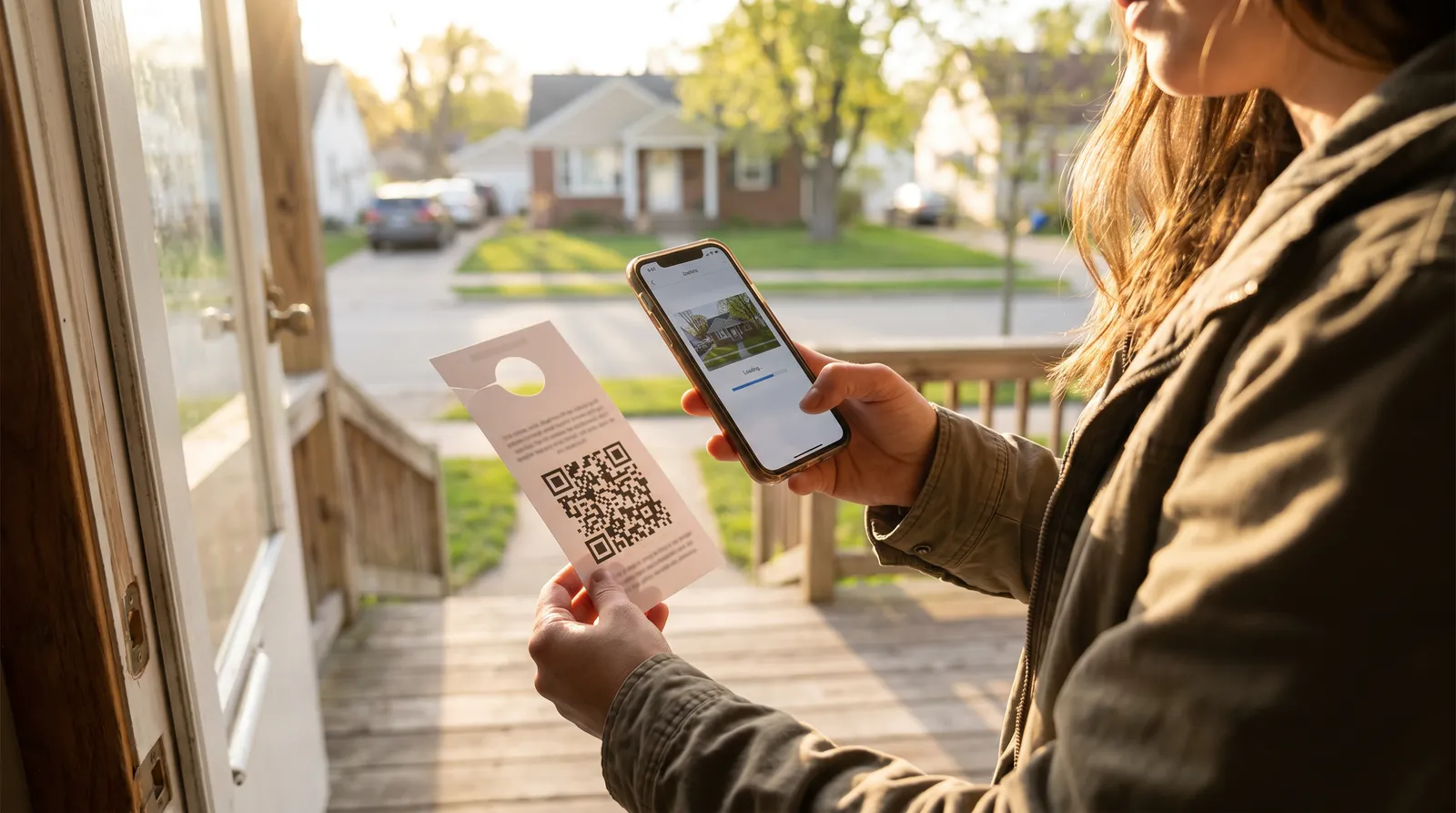
This is the play most painters miss because they're not thinking about Paintviz as a marketing tool, just as an estimate tool. It's both.
Here's the workflow:
- Generate a Paintviz share link in your dashboard. Toggle "lead capture" on. The link lands the homeowner directly into the visualizer with their email/name captured before unlimited renders.
- Make a QR code for that link. Free generators exist; most painters use QR Code Generator or one of a hundred similar tools.
- Print the QR code on whatever physical marketing you already do. Door hangers, postcards, direct mail, flyers, business cards, yard signs after the job's done, the back of your truck, the back of the proposal.
- Hook copy under the code: something like "See your house in any color in 20 seconds, scan to try" or just "Paint your property in 20 seconds."
- The homeowner scans, opens the visualizer, uploads a photo of their actual house, generates a render. The moment they generate, Paintviz captures the lead and the photos and the colors they tried, and it lands in your dashboard.
Why this is the universal entry point: most painters already drop door hangers and flyers. Most don't have a website that gets meaningful traffic. The QR code converts the physical marketing they already pay for into measurable lead capture. No website required. No developer required. No Zapier setup needed unless you want to pipe leads into a CRM.
It also captures top-of-mind leads in a way Angi can't. The homeowner who scans the QR on a door hanger isn't shopping. They're playing. Three minutes later they're imagining their living room in Hale Navy and filling out their email to keep going. That's a hotter lead than someone who fired off a quote request to four random painters on Angi at 11 PM.
Embed the visualizer on your website (for painters with traffic)
The other Paintviz lead-capture path is the embed widget. Drop a single iframe on your home page, services page, or paid-ad landing page. Same lead-capture mechanics as the QR + share link, just a different surface.
The embed makes more sense than the QR code when you've got real website traffic to convert. That's painters running paid ads that need a higher-converting landing page, painters who rank locally and convert under 3% of visitors, and multi-crew shops where the website is a real revenue channel.
For a deeper walk-through, see the embed-widget use case page. Most painters who run real lead-gen volume use both surfaces: QR codes on physical marketing for top-of-mind capture, embed on the website for paid-traffic conversion.
A real case study: Painter Pro
Sam Reuter at Painter Pro in Indianapolis added Paintviz to his sales process and his website in 2025. Real numbers from his first 90 days:
- Website lead conversion: 6.2% → 8.7% (+40%)
- Closing rate on estimates: 28% → 37% (+32%)
- Average project revenue: $3,800 → $4,350 (+14%)
Sam started by dropping the embed on his website and saw immediate lift on form-fill leads. He also started sending paintviz share links to past clients, which generated unexpected new business: of five past clients he sent links to, three scheduled new quotes and two became signed jobs.
What worked for Sam isn't unique to him. The pattern is universal: when the homeowner can see what the finished house will look like before they talk to the painter, they convert at a higher rate, and they convert at a higher price point.
SEO, Google Ads, Local Service Ads, Meta Ads: what each is good for
Each paid channel has a different sweet spot. Painters who treat them all the same waste money.
Google Search Ads (PPC). Bid on terms like "house painters [city]" or "interior painting [city]." High intent, expensive ($25-$75 per click in competitive metros), works best with a strong landing page that converts above 5%. If your landing page is your generic home page, expect to lose money for the first 90 days. Run with a dedicated landing page or don't bother. The Paintviz embed on a paid-ad landing page is a meaningful conversion lift here.
Local Service Ads (LSAs). Google's verified-pro listings show up above regular search results. Pay-per-lead at $20-$70 per qualified call. Faster than organic, lower CPC than search ads, but you need a solid review profile and you need to answer the phone fast. The Google Guaranteed badge is a real trust signal homeowners notice.
Meta Ads (Facebook + Instagram). Better for top-of-funnel awareness than direct lead-gen for painting. Most painters who succeed on Meta are running before-and-after photo ads to retargeting audiences (people who visited the site but didn't convert). Cold-audience Meta painting ads are expensive and tire-kicker-heavy.
Organic SEO + Google Business Profile. The slow durable channel. Takes 6-9 months to start working, takes 12-18 months to dominate, then keeps paying off for years. Your Google Business Profile is the single most under-optimized asset most painters own. Fill out every field, add 50+ project photos, get to 30+ reviews, post weekly updates.
For most painters, the right blend at first is strong Google Business Profile + small Google Ads budget targeting one or two high-intent keywords + Paintviz lead-capture surfaces (QR codes on physical marketing, embed on the site). Skip Meta and Angi for the first six months unless you have specific reasons not to.
Building your lead-gen stack
Practical recommendations by business size:
- Solo painter or 1-crew (under $500K). Free or near-free: Google Business Profile dialed in, paintviz share link with lead capture turned on, QR code on every door hanger and flyer you already drop. Skip paid ads until you've maxed organic.
- Small to mid crew ($500K-$3M). Add: Google Search Ads on 2-3 high-intent local keywords, Paintviz embed on the home page, an estimating CRM with automated follow-up (PaintScout, Jobber, or DripJobs, see our painting estimating software guide). Optional: LSA verification.
- Multi-crew ($3M+). Add: meaningful Google Ads budget ($2K-$5K/mo), retargeting on Meta, dedicated landing pages per service line, marketing dashboards showing cost per closed job by channel. The Paintviz embed becomes a meaningful lead source at this scale.
The mistake most painters make is buying tools they don't use. Pick the smallest stack that you'll actually run every week, then add layers when you've maxed what you have.